When it comes to aquarium maintenance, one question that often comes up among fish keepers is whether it is better to perform a large water change once a week or make smaller water changes more frequently.
The answer is not the same for every aquarium, but small, regular water changes can be a very effective approach, especially in aquariums with messy or heavily fed fish such as Flowerhorns.
A small water change does not magically make an aquarium healthy. What matters most is maintaining stable water parameters, removing accumulated waste, keeping the filter functioning properly, and avoiding sudden changes that can stress the fish.
So, could small daily water changes actually be better for your fish?
In some situations, yes.
Why Do Aquarium Water Changes Matter?
Fish continuously add waste to their environment. Uneaten food, fish waste and other organic material break down in the aquarium and can contribute to ammonia and other nitrogen compounds.
A properly established biological filter helps process these compounds through the nitrogen cycle. However, filtration does not mean that you never need to change the water.
Over time, different substances can accumulate in aquarium water. Regular water changes help dilute these unwanted compounds and replenish some of the minerals and other components of the water.
This is particularly important for fish that produce a lot of waste.
Flowerhorns are a good example. They are relatively large, active fish and are often fed frequently. A single fish in a reasonably sized aquarium can produce a surprising amount of waste.
That is why water quality should be treated as part of the fish’s everyday care rather than something you only think about when the water looks dirty.
What Is a Small Daily Water Change?
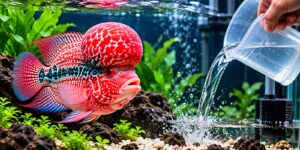
A small daily water change simply means removing a relatively small amount of aquarium water and replacing it with properly prepared water each day.
For example, instead of removing a very large percentage of the aquarium water once every several days, a fish keeper may remove a smaller percentage more frequently.
The exact percentage depends on the aquarium.
There is no universal rule saying that every fish tank needs exactly a particular percentage every day. Tank size, fish size, stocking level, feeding habits, filtration, water parameters and maintenance routine all matter.
The important principle is consistency.
A small water change performed regularly can gradually remove waste while causing less dramatic change in the aquarium’s overall conditions.
Why Smaller Changes Can Be Easier on Fish
One potential advantage of smaller water changes is stability.
Fish live in the water, so changes in temperature, pH, hardness and other water characteristics can affect them.
If a very large water change introduces water with significantly different characteristics, the aquarium can experience a sudden change.
With smaller changes, the difference introduced at one time may be less noticeable, provided the replacement water is appropriately prepared and reasonably close to the aquarium’s existing conditions.
This does not mean that large water changes are automatically dangerous.
A large water change can be completely appropriate when the aquarium requires it, particularly when there is a serious water-quality problem. The key is to perform it correctly and avoid creating a sudden, unnecessary shock.
Small Daily Water Changes vs One Large Weekly Change
Both approaches can work.
A weekly water-change routine is simple and practical for many aquariums. For example, a fish keeper might perform one appropriately sized water change every week while monitoring the aquarium’s water quality.
A more frequent routine may be useful for aquariums where waste builds up quickly.
Think about it this way:
If waste is continuously being produced, removing some of it regularly can help prevent a large accumulation between maintenance sessions.
However, there is an important point here.
More frequent water changes are not automatically better.
If your aquarium already has excellent water quality and your fish are healthy, unnecessarily changing large amounts of water every day may provide little additional benefit and could create instability if the replacement water differs significantly from the tank water.
The goal should be stable, clean and suitable water, not simply doing as many water changes as possible.
Why This Can Be Useful for Flowerhorns
Flowerhorns are often fed nutrient-rich foods, and many keepers want to encourage healthy growth, colour and development.
More food generally means more waste.
This is where regular maintenance becomes important.
If you feed your Flowerhorn heavily but do not adjust your maintenance routine accordingly, waste can accumulate faster than you expect.
A small, frequent water-change routine can therefore be useful for a Flowerhorn aquarium, especially when combined with:
Good mechanical filtration
Effective biological filtration
Regular removal of uneaten food
Proper feeding quantities
Adequate aquarium size
Regular water testing
Consistent temperature
Good overall aquarium hygiene
Water changes should be part of the entire maintenance system rather than a replacement for good filtration and responsible feeding.
Does Clear Water Mean the Water Is Healthy?
Not necessarily.
This is one of the biggest mistakes beginners can make.
Aquarium water can look perfectly clear while still having unsuitable water chemistry.
Ammonia and nitrite, for example, are not necessarily visible to the naked eye.
A tank can look clean and still have a water-quality problem.
This is why experienced fish keepers do not rely only on appearance.
Testing water parameters can provide much more useful information about what is actually happening inside the aquarium.
If you are trying to decide whether your current water-change routine is enough, testing is much more useful than simply looking at the water and deciding that it appears clean.
Is a 5% Daily Water Change Better Than a 30% Weekly Water Change?
Not necessarily.
This is an important distinction.
A 5% daily change and a 30% weekly change are not directly equivalent, and their effectiveness depends on what you are trying to accomplish.
Small daily changes continuously dilute some waste, while a larger periodic change removes a greater proportion of the accumulated water at one time.
For many aquariums, a properly performed weekly water change may be perfectly adequate.
For others, more frequent changes may make sense.
The best routine depends on the aquarium rather than the percentage alone.
Final Thoughts
There is no single water-change schedule that is perfect for every fish tank.
A small daily water change can be a useful strategy, especially for fish such as Flowerhorns that can produce a significant amount of waste.
However, don’t get caught up in the idea that more water changes always mean healthier fish.
Good aquarium care is about balance.
Feed responsibly, maintain effective filtration, remove waste, monitor water parameters, prepare replacement water correctly and keep conditions as stable as possible.
If your aquarium requires frequent water changes to maintain good water quality, that is useful information. It may also be worth looking at the bigger picture, including tank size, stocking, feeding habits and filtration.
Ultimately, the goal is not to change water as often as possible. The goal is to provide your fish with clean, stable and suitable water.