
Biggest Drawbacks of Keeping Flowerhorns in a Small One or Two Feet Tank
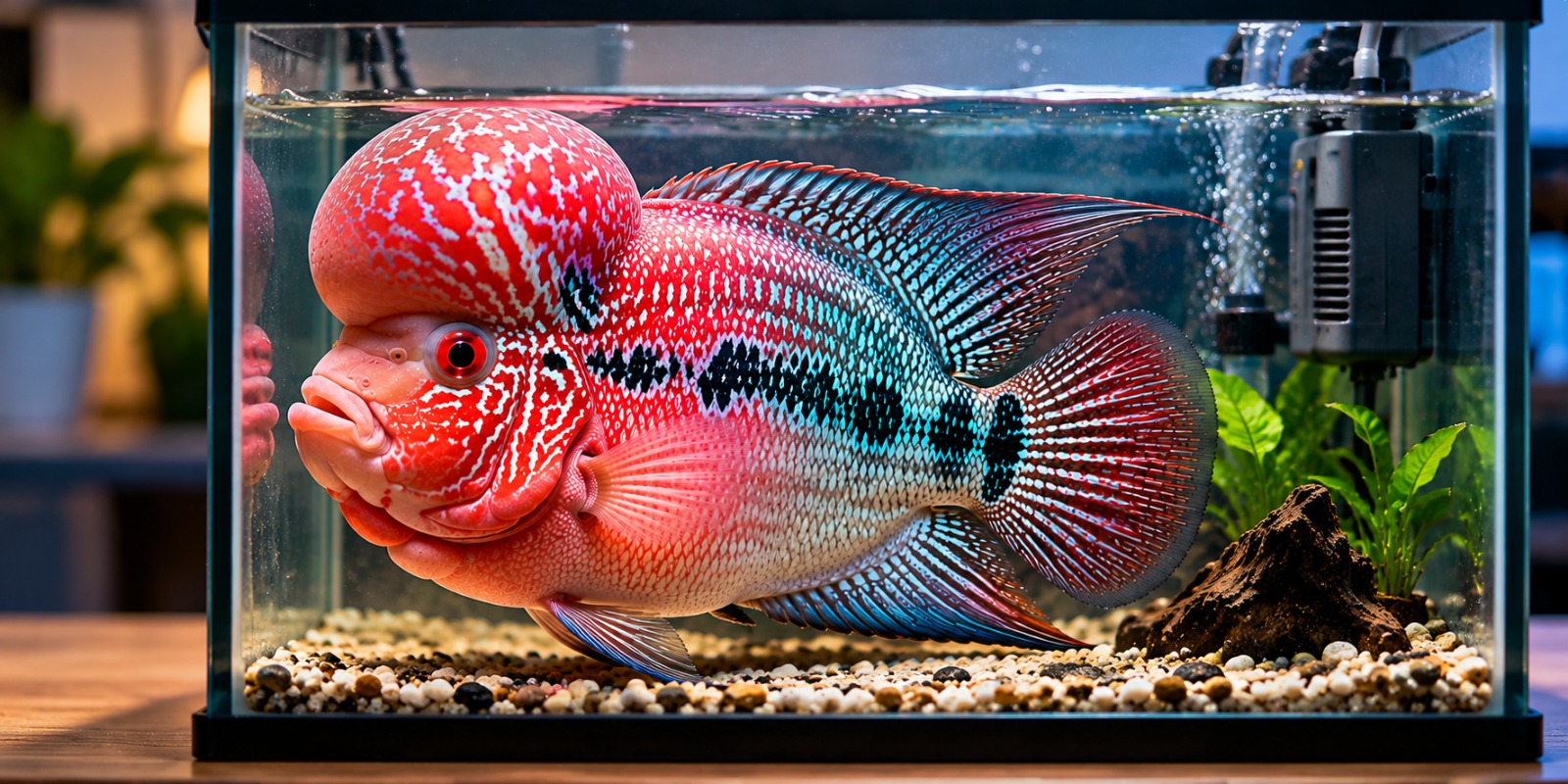
Picture yourself purchasing a stunning 3-inch Flowerhorn with vivid colouring and good pearlisation and some head kok too.
You then construct either a one foot or two foot aquarium, fit a filter and add some ornaments. Finally you place your new pet into the tank.
In the initial days everything seems to be going well.
Your fish happily moves around the tank, responds well to you looking through the aquarium glass and eats well. Thus you are pleased with your choice.
As your Fish is currently quite small, why would it need a large tank?
Unfortunately, however, many novices fail to appreciate that:
Whilst a tank may seem adequate for a young Flowerhorn, it can in fact soon prove to be too small for the mature fish.
Flowerhorns are lively and strong. As a result they generate a lot of waste and so require more than simply sufficient water. In addition, they require appropriate water parameters, an appropriate filter and an environment which will promote good health – as well as adequate room in which to swim.
Although initially it may seem that a small aquarium is suitable for a Flowerhorn, there are potential issues which can arise and to which it can become more difficult to address as time goes on.
Therefore within this article I will examine the main negative aspects of housing a Flowerhorn within a small 1 or 2 foot aquarium. I will explain why these issues can arise and highlight points to bear in mind when selecting an aquarium for your Flowerhorn.
1. Restricted Swimming Room
Firstly, let us consider the issue of limited space.
Whilst some Flowerhorns do not get very large, depending on both their lineage and growth, many can develop into fairly large specimens (often being around 10–12 inches or even larger).
Consider then a 10 inch Flowerhorn housed within a 12 inch long tank.
Although the Fish could physically be placed within this aquarium, this would still not constitute a good environment for it.
If you were confined to living in a room which was only slightly longer than your own height, how would you feel?
Even if you could manoeuvre yourself around, your movement options would be greatly restricted.
As previously mentioned, a Flowerhorn needs to be able to swim, turn and investigate its environment. It also requires space in which to exhibit its natural behaviour.
A small aquarium does not offer the Fish sufficient room to do this, particularly as it ages.
For these reasons, basing your aquarium selection purely upon the size of the Fish at present can be unsuitable.
You must select an aquarium appropriate for the Fish that you are rearing, not merely that which you are purchasing at this stage.
2. Water quality
Poor water quality is often an issue for those who house a Flowerhorn in a small aquarium.
Not only do fish excrete waste, but uneaten food and organic matter will also decay.
During this decay, ammonia can be released into the water.
Although ammonia is harmful, even low levels can be dangerous and this will depend on the water’s condition.
Good quality biofiltration can allow ‘good’ bacteria to process ammonia so that it is changed to nitrite and then to nitrate. The biofilter must though be able to cope with the waste produced.
Now consider that a fairly large, well fed Flowerhorn is housed in a small body of water.
There is a reduced volume of water to spread the fish’s waste around.
Should the waste produced exceed the capacity of the aquarium’s filtration system, ammonia and/or nitrite can build up rapidly.
Whilst it is not necessarily always the case, a small aquarium can still be well managed and so provide suitable water conditions for the right type of fish in the right circumstances.
Generally though, a large and dirty fish is more likely to be affected by errors in its housing, due to the restricted space.
An absence of maintenance, over-feeding or issues with the filter can all prove to have far more severe outcomes.
Also bear in mind that although water may appear clear, it could still be unsafe.
3. Temperature and water conditions can alter more easily
Have you ever realised how much quicker a small body of water can heat up or cool down than a far larger one?
Whilst aquariums are not precisely the same as standard vessels, broadly speaking, the smaller the body of water, the lower its thermal resilience.
A small aquarium can therefore see more drastic temperature fluctuations if the room it is situated in heats up or cools down.
This can be especially relevant if there are considerable variations in room temperature throughout the day and/or between seasons.
Heating equipment can be employed to try and regulate temperature. Once again though, it is essential that the right type of heater is used and that it is operated safely.
Alongside temperature, water chemistry must also be considered. Again, factors such as waste, feeding and filtration, together with water changes, can all influence this.
Should there be abrupt alterations to your aquarium’s water conditions, your Flowerhorn may suffer from stress.
Nevertheless, a small aquarium does not inevitably lead to a stressed fish if it is suitably stocked and maintained.
The key point is that small aquariums often need closer supervision as they are prone to seeing more rapid changes to their conditions.
For a fish which requires steady water conditions, this is a key negative aspect of a small aquarium.
4. Managing Flowerhorns
Flowerhorns are lively and characterful fish.
Many will come to the front of the tank when their owner approaches. Some will also watch activity outside the tank, defend areas within the tank and even investigate items in the aquarium.
These are all engaging aspects of Flowerhorn behaviour.
What if a fish is both keen to explore and is restricted in where it can go?
Within a small aquarium there is less scope for exploration.
Indeed, a small fish tank may also offer insufficient space to include appropriate tank furnishings which at the same time, do not impede the fish’s swimming.
Whilst some Flowerhorns may be affected by being housed in a small aquarium, it is not possible to determine solely from tank size and behaviour whether a fish is stressed.
Constantly walking up and down the front of the tank, atypical sheltering behaviour, loss of appetite and/or aberrant swimming should never be overlooked.
As previously mentioned, these symptoms can occur due to inappropriate husbandry, disease and/or environmental stress.
Increasing the size of and optimally designing an aquarium enables you to better establish an appropriate environment and to effectively monitor a fish’s typical behaviour.
5. Small tanks are not a good method of managing a Fish’s Kok
Many hobbyists are often unsure about this area.
Some think that by housing a Flowerhorn in a small tank, they can manage the fish’s body size and encourage kok formation.
Furthermore, many people consider that if a fish has a large kok and is itself small then it must be of high genetic quality and will without doubt become a monster head Flowerhorn.
Unfortunately, neither of these views is accurate.
Various elements affect a Flowerhorn’s kok, these include genetics, personal growth, age, and health, alongside general husbandry.
Tank size alone does not determine a specific kok form or dimension.
It is not good practice to house a fish in an inappropriately sized tank with the aim of managing its body size. Although sub-optimal conditions can impact negatively upon a fish’s health and growth, they do not consistently and favourably influence body shape.
Although a Flowerhorn may appear in great body condition at 3 inches, its body could further develop in a different way.
Conversely, another fish of similar age with a less extensive kok may in later life form a more pronounced hump.
There is no tank size which will assuredly result in a specific kok morphology.
To successfully rear a Flowerhorn in good body condition and with good growth, it is key to ensure that it is housed in an appropriate tank, fed a well-balanced diet and that water quality is maintained consistently. Good general husbandry is also essential.
Therefore, a Small Tank Is Not a good solution for optimally managing kok formation.
6. Increased importance of filtration
Compared to its size, a Flowerhorn can generate a large amount of waste.
Therefore good filtration is key.
In addition to mechanical filtration which can be used to clear floating matter and leftover food, biological filtration can also be employed. This involves using a medium to support good bacteria which can break down ammonia and nitrite.
Whilst both methods are important, good water changing is still required.
Within a small aquarium, the filter could need to manage quite a large amount of waste, again compared to the volume of water.
Poor filtration can thus affect water quality, whether due to a filter which is too small, blocked or which does not allow sufficient water flow through. Insufficient biological filtration can also result in poor water quality.
Although a strong pump can be utilised, this alone is not always the answer.
Alongside appropriate mechanical and biological filtration, the flow within the tank should also not hinder the ease with which fish can swim.
Although good filtration can aid water quality, it is no substitute for a tank which simply is not large enough to house fish effectively.
7. Possibly increased levels of maintenance
Many novices decide to have a small fish tank as it is often seen as easier to manage.
Smaller tanks hold less water and are also generally cheaper to establish.
However, maintaining a tank containing a dirty fish can actually involve more work.
As previously explained, waste can build up fast compared to the volume of water present. Regular observation and correctly-sized water changes may then be necessary.
It is also common to need to inspect and clean your filter more often, along with routinely investigating and analysing water quality.
Despite adhering to a thorough maintenance programme, there is generally less room for mistakes within a small aquarium.
For instance, overfeeding is likely to have a bigger effect within a small tank than within a larger, well-filtered aquarium.
Furthermore, issues with the filter or non-occurrence of water changes can adversely affect water quality more swiftly within a small aquarium.
Whilst not all small tanks will require daily water changes, the correct frequency will depend on the specific circumstances and analysed water quality of each aquarium.
In short, a small fish tank does not necessarily involve reduced levels of maintenance.
At times, greater attention must be given to all aspects of maintenance.
8. Reduced scope for secure and stimulating furnishings
Being inquisitive, Flowerhorns can benefit from a stimulating yet well thought-out aquarium.
Yet furnishings do take up space.
Even in a one foot tank, a modest rock, fake cave or ornament can take up a large section of the available area for fish to swim in.
Furthermore, fish can be harmed by sharp furnishings. Poorly sited items can also impede a fish’s movement and become trapped with waste.
Within a small aquarium there is also a limited range of ways to furnish the tank so that it is both stimulating and not cramped.
Conversely, a larger aquarium allows for greater scope to design an engaging tank, all the while ensuring that there is ample space for fish to swim.
Appropriately shaped, secure furnishings can be selected and items can then be suitably situated. Sufficient space can also be guaranteed for the fish to manoeuvre.
Rather than cramming as many furnishings into a tank as possible, the ideal is to construct a secure, open and stimulating environment.
Typically, a secure, open and stimulating environment is a more effective way to furnish a tank for a Flowerhorn.
9. Small tanks can exacerbate issues
Your Flowerhorn stops eating.
It is then seen to shelter behind the filter and produce atypical white slimy faeces.
You will instinctively start to analyse what is going on in your aquarium.
Whilst the temperature is fine and the water seems clear, the filter is also operating.
Further analysis is then required.
Water quality can deteriorate rapidly in a small aquarium if the filter is unable to cope with the amount of fish waste produced.
Whilst tank size and water quality can contribute to health issues, they are not always the root cause.
Reduced appetite can also result in white slimy faeces. Furthermore, digestive and/or parasitic issues can similarly lead to this type of waste. Unfortunately, this is not conclusive evidence of a particular disease.
Although a larger aquarium can alleviate some issues, a small aquarium does not necessarily cause fish to become unwell.
Good aquarium size and filtration can therefore help to ensure more consistent water quality and minimise avoidable issues.
If your Flowerhorn is producing continual atypical faeces, has a reduced appetite and/or appears to be losing condition or behaving abnormally then analyse your water quality and seek relevant aquatic veterinary advice where necessary.
However, do not simply presume that a bigger aquarium will resolve the issue.
10. You May Fail To Recognise That Your Aquarium Has Become Too Small
This is often the most typical error made by novice aquarists.
They purchase both a small aquarium and a small specimen of Flowerhorn.
Initially, as the fish is only two or three inches in length, the aquarium seems perfectly adequate.
However, over time, the fish continues to grow. Consequently, it becomes bulkier and its activity level rises. Alongside this, waste production also increases as the fish eats and expands.
Unfortunately, the aquarium remains the same size.
Whilst the fish can continue to both eat and swim, an individual may fail to recognise that their aquarium has become inadequate. Eventually though, it becomes more evident that the aquarium is no longer ideal.
The fish has restricted swimming area and there is greater work involved in caring for the aquarium. Ultimately, it will become essential to enhance the aquarium.
Therefore, it is highly important to consider future requirements.
Consider how big an adult Flowerhorn is likely to become, alongside the current aquarium size, filtration needs and the available room in your house. Also, analyse your long-term costs for aquarium care.
If you cannot offer an appropriate aquarium for your growing (or indeed adult) Flowerhorn then it is preferable to consider in advance how you will enhance your aquarium prior to acquiring your fish.
11. How Big Should My Aquarium Be?
Whilst there is no universally applicable aquarium size for all Flowerhorn, factors such as adult size, shape, swimming area, filtration and aquarium size all require consideration.
Typically, many people who care for adult Flowerhorns feel that an aquarium of approximately four feet in length, and often of 75-100 plus US gallons in volume (depending on the aquarium’s proportions and the particular fish), is suitable.
Whilst not guaranteed to be suitable for all, a four foot aquarium unquestionably offers much greater swimming area than either a one or two foot aquarium.
A two foot aquarium can on occasion be utilised in specific short term scenarios (for example, for quarantine or interim use). Again, this will depend on the fish and will require meticulous handling. But it should never be presumed to be a long term suitable aquarium for both growing and adult Flowerhorns.
Furthermore, when selecting an aquarium, not just length but also width and water volume should be analysed. Even if a tall and skinny aquarium holds an acceptable volume of water, it may not offer sufficient lateral swimming area.
In addition, a larger aquarium will require an appropriate stand, safe electrical components and suitable filtration.
The aspiration is to select an aquarium that will suit your fish for its whole lifetime.
12. I Already Have My Flowerhorn In A Small Aquarium
Whilst you should not become unduly worried if your Flowerhorn is currently housed within a one or two foot aquarium, it is important that you realistically evaluate your current circumstances.
Analyse your aquarium size, your fish’s size, water quality, filtration, and dietary provision. Observe your fish’s behaviour too.
If it is evidently clear that your aquarium is no longer appropriate for your fish then consider how you will enhance your aquarium provision.
During this process, ensure that your filtration is working effectively. Remove any surplus food and regularly analyse your aquarium water. Undertake suitable water changes.
Never abruptly alter your aquarium’s temperature and/or water composition.
When relocating your fish to a larger aquarium, correctly set up and confirm that the new aquarium is both safe and appropriate. Never presume that freshly filled aquarium water is automatically bio-compatible. It will be necessary to establish biological filtration and to monitor ammonia and nitrite levels.
If your fish is already displaying health concerns then in addition to analysing aquarium related issues, separately analyse these health related issues. Do not automatically attribute them solely to tank size.
Every endeavour should be made to enhance your fish’s environment in a manner that does not further stress it.
Final Thoughts – Your Flowerhorn Merits More Than Adequate Living Space
Although a one or two foot aquarium may initially appear attractive, be inexpensive and be conveniently sized, this may not continue to be appropriate as your Flowerhorn matures.
As well as analysing whether your aquarium can physically accommodate your fish, it is vital to evaluate whether it can effectively cater for it as it develops.
Insufficient swimming area, less consistent water quality, greater care effort and inability to even house a large fish are all significant issues.
Whilst a strong filter is beneficial, it cannot compensate for inadequate swimming area. Likewise, the size of a kok is irrelevant to a fish’s wellbeing.
Cultivating an attractive, colourful and shapely Flowerhorn is indeed important. However, it is equally crucial that the fish is offered an environment in which it can swim, eat and stay well.
Before purchasing a juvenile Flowerhorn, consider the adult fish’s characteristics. Then, source an appropriate aquarium and set up suitable filtration. Consider long term care too.
If your Flowerhorn is already housed in a small aquarium then use this as a catalyst to further enhance its environment.
Certainly, as well as being aesthetically pleasing, a Flowerhorn merits an aquarium that will promote its wellbeing for many years into the future.
Thank you for taking the time to read this article. Should you have found it informative please disseminate it to other Flowerhorn carers so that more people can recognise the significance of correct aquarium sizing.
Better Fishkeeping Begins With Better Care – Blue Aquatics.
Search Articles
Categories


Join the Blue Aquatics Community
Stay updated with the newest tips, guides, and aquarium knowledge.