
Why Does My Parrot Fish Always Follow the Flowerhorn in the Tank? An Interesting Theory You Never Heard Before
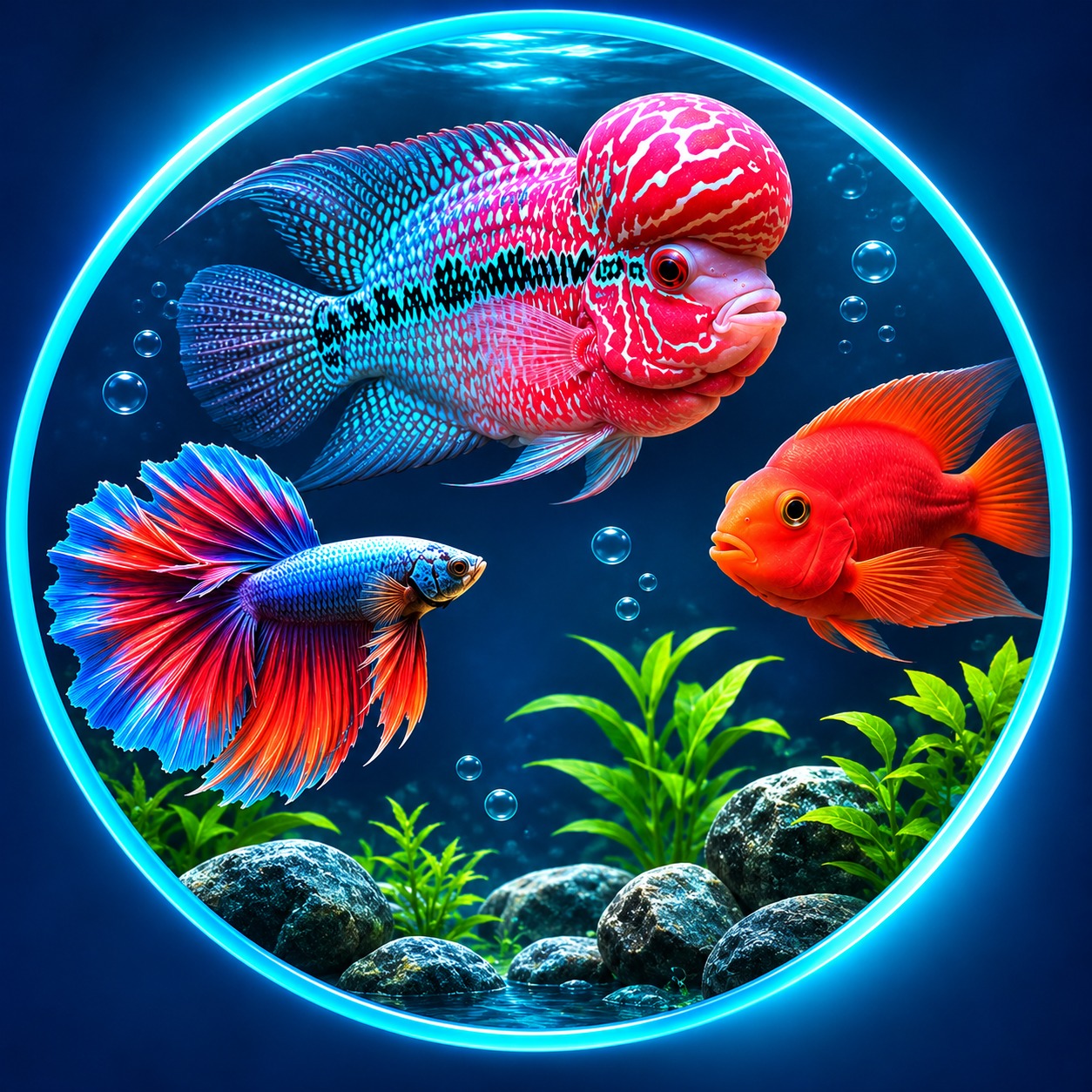
Have you ever watched two fish swimming together in an aquarium and wondered what is actually going on inside their little underwater world Imagine this. You have a beautiful Flowerhorn swimming around the tank. It moves from one corner to another, explores the decorations, comes near the glass, and sometimes stops for a few seconds. But there is something interesting happening behind it. Your Parrot fish is following.
The Flowerhorn moves to the left, and the Parrot fish also moves to the left. The Flowerhorn swims towards the front glass, and the Parrot fish comes along. Sometimes, the Flowerhorn changes direction, and the Parrot fish seems to follow it again. Now, here is the question.
Is the Parrot fish simply swimming around the tank, or is there a reason why it keeps following the Flowerhorn?
Could it be curiosity? Could it be a learned routine? Could the Flowerhorn be giving the Parrot fish some kind of signal without even knowing it?
Or are we looking at something that we, as fish keepers, often misunderstand?
Welcome back to Blue Aquatics, where we explore the fascinating world of aquarium fish, their behaviour, and the little things that make fish keeping so interesting.
Today, we are going to talk about a behaviour that many fish keepers may notice when keeping a Flowerhorn and a Parrot fish together.
And by the end of this video, you may look at your own aquarium a little differently.
1. The Interesting Behaviour That Started This Question
Let us begin with a simple observation.
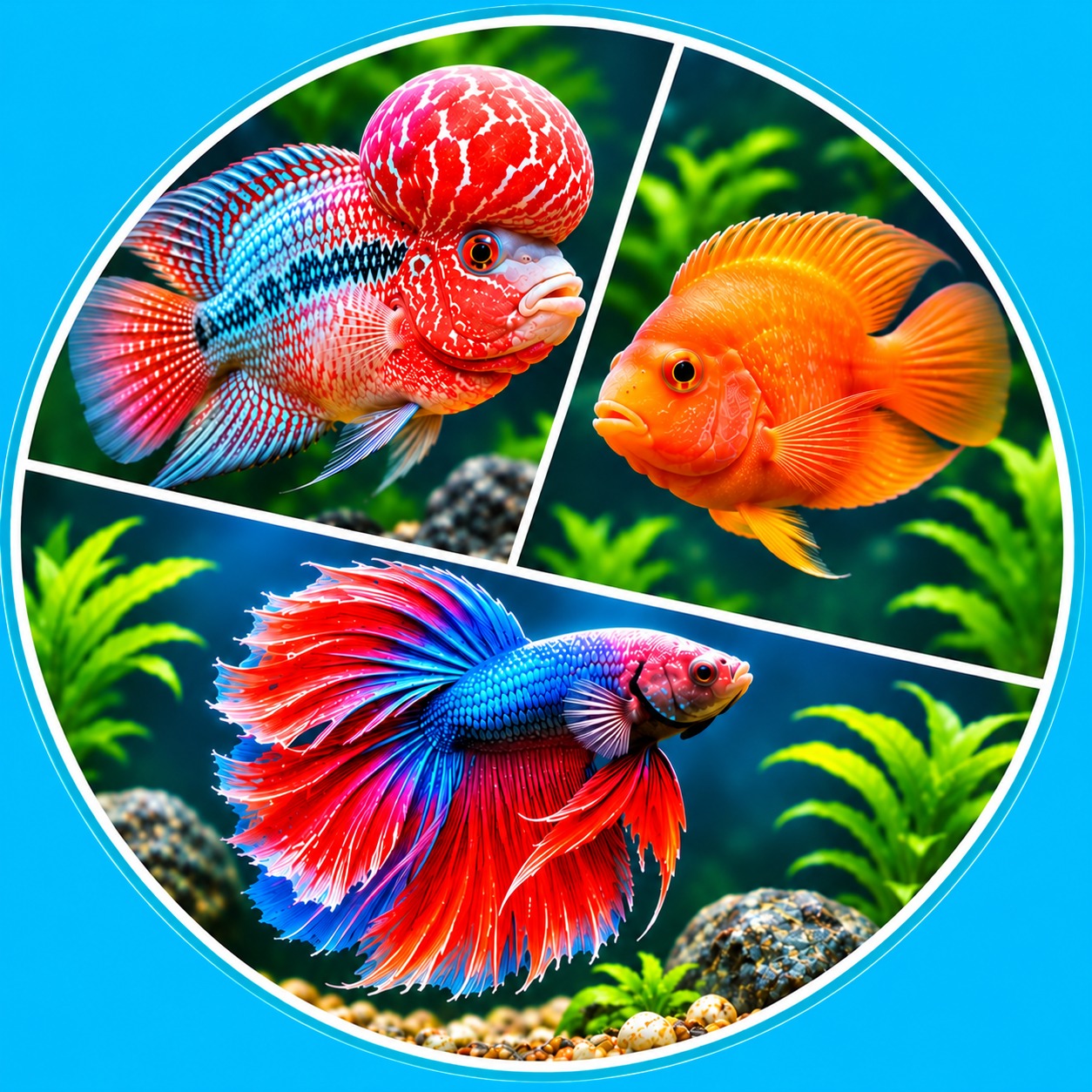
Imagine a Flowerhorn and a Parrot fish living in the same aquarium. Both have their own appearance, their own swimming style, and their own way of reacting to things around them.
The Flowerhorn is often curious about its surroundings. It may approach the aquarium glass, investigate objects, react when its owner comes near, or move around its territory.
The Parrot fish may also explore the aquarium, search for food, and react to movement around the tank.
Now, when these two fish live together, something interesting can happen.
The Parrot fish may often be seen swimming near the Flowerhorn.
Sometimes it follows the Flowerhorn for a few seconds. Sometimes both fish move in the same direction. And sometimes the Parrot fish may appear to stay close to the Flow1erhorn for a longer period.
When we see this, our first reaction may be to give the behaviour a human meaning.
We might say that the Parrot fish likes the Flowerhorn.
We might even think they have become friends.
And honestly, it is easy to understand why we think this way.
As fish keepers, we spend time watching our fish every day. We start recognising their habits, their feeding responses, their favourite places, and their normal behaviour.
Over time, even a small change can catch our attention.
But there is an important difference between what we observe and what we think that observation means.
We can observe a Parrot fish following a Flowerhorn.
However, we cannot automatically conclude that the Parrot fish is following it because of friendship or affection.
To understand what might be happening, we need to look a little deeper.
2. My First Theory: What If the Parrot Fish Is Learning a Routine?
Here is the first theory I want you to think about.
What if your Parrot fish is not deliberately trying to follow the Flowerhorn, but has learned that certain activities often happen when the Flowerhorn moves?
Let me explain.
Suppose you feed both fish at approximately the same time every day.
Before feeding, the Flowerhorn may swim towards the front of the aquarium. It may become more active, approach the glass, or move around the area where food usually appears.
The Parrot fish may notice this pattern.
It may also begin moving towards the same area because it has learned that food often arrives there.
Now imagine that this happens repeatedly.
Day after day, the fish experience a similar routine.
The Flowerhorn moves towards the front.
The Parrot fish also comes towards the front.
Food arrives.
Both fish eat.
After many repetitions, their movements may start looking connected.
To someone watching the aquarium, it might seem as if the Parrot fish is following the Flowerhorn everywhere.
But the Parrot fish could actually be responding to a familiar routine, a feeding opportunity, or the same environmental signals.
Fish can learn associations between events and their surroundings. Aquarium fish may learn to recognise feeding routines and react to familiar cues.
This does not prove that every following behaviour is related to food. It simply gives us one reasonable explanation to consider.
And this is where the behaviour becomes interesting.
Sometimes, what looks like a special relationship between two fish may partly be the result of habits they have developed while living in the same environment.
Think about your own aquarium.
Does the Parrot fish follow the Flowerhorn more often before feeding?
Does it come closer when the Flowerhorn approaches the front glass?
Does the behaviour also happen when there is no food involved?
These small observations can help you understand what might be happening.
Instead of immediately deciding why the Parrot fish is following, try to notice when it happens.
The timing may tell you more than the movement itself.
3. My Second Theory: The Flowerhorn May Be Acting Like a Moving Signal
Now let us explore another possibility.
Imagine that you are watching your aquarium, and the Flowerhorn suddenly swims towards one side of the tank.
A few seconds later, the Parrot fish moves in the same direction.
The Flowerhorn explores another area, and the Parrot fish follows again.
Why might this happen?
One possibility is that the Flowerhorn’s movement attracts the Parrot fish’s attention.
Think about it from the Parrot fish’s point of view.
Something moves nearby.
That movement may be interesting enough to investigate.
The Parrot fish changes direction and moves closer.
The Flowerhorn moves again, and the Parrot fish responds once more.
This could create a pattern where one fish appears to be leading and the other appears to be following.
But here is the important point.
Following another fish does not necessarily mean that the following fish has chosen it as a leader.
It may simply be reacting to movement.
We see similar patterns in many animal behaviours, where one individual’s actions can influence the movements of another. However, the exact reason depends on the species, the environment, and the situation.
We should not assume that a Flowerhorn is deliberately guiding a Parrot fish around the aquarium.
It may not even be aware that the other fish is following it.
The Parrot fish could simply be responding to something happening nearby.
This is why observing the same behaviour in different situations is so useful.
If the Parrot fish follows only when the Flowerhorn makes sudden movements, that is one clue.
If it follows even when the Flowerhorn is resting, that suggests we should consider other explanations.
And if both fish frequently swim together without one consistently following the other, their movements may simply overlap because they use the same areas of the tank.
The more carefully we observe, the less we need to guess.
4. My Third Theory: They May Be Using the Same Favourite Areas
Here is another explanation that aquarium owners sometimes overlook.
What if the Parrot fish is not really following the Flowerhorn as much as we think?
What if both fish simply prefer the same areas of the aquarium?
Let us say your Flowerhorn spends a lot of time near the front glass.
Perhaps that is where it usually receives food.
Maybe it enjoys exploring that area, or it has become familiar with the surroundings.
Now the Parrot fish also spends time near the front glass.
When you look at the tank, you see the Parrot fish behind the Flowerhorn.
It looks like following.
But there may be another explanation.
Both fish are visiting the same area because it is familiar, interesting, or associated with food.
The same thing can happen near aquarium decorations, open swimming spaces, or places where the fish regularly spend time.
In a small aquarium, the effect can be even more noticeable because there are fewer areas to explore.
Two fish sharing the same swimming space may repeatedly cross paths, even if neither fish is intentionally following the other.
This is why the layout of your aquarium matters.
Where do both fish spend most of their time?
Do they frequently meet in the same corner?
Does the Parrot fish follow the Flowerhorn throughout the tank, or does it mainly appear near the same favourite locations?
These questions can help you distinguish between repeated shared movement and a more consistent following pattern.
And remember, the goal is not to prove that one theory is correct.
The goal is to understand your fish better.
5. But What If the Parrot Fish Actually Feels Comfortable Around the Flowerhorn?
Now let us consider something a little more interesting.
What if the Parrot fish repeatedly chooses to stay near the Flowerhorn, even when there is no food involved?
Could that mean the Parrot fish is comfortable around it?
It is possible that the two fish have become familiar with each other’s presence.
When fish share an aquarium over time, they may become accustomed to the presence and movements of other fish.
A fish that previously reacted strongly to another fish may later show a different response as it becomes familiar with the situation.
However, familiarity does not always mean friendship, and being close to another fish does not automatically prove that the relationship is peaceful.
To understand whether the Parrot fish is comfortable, we need to look beyond following behaviour.
Does it swim normally?
Does it eat properly?
Does it have access to food?
Can it move away whenever it wants?
Does it use different areas of the aquarium?
Does it show any signs of repeated chasing, hiding, injury, or stress?
These observations are much more useful than simply seeing the fish swim together.
For example, a Parrot fish that swims near a Flowerhorn but can freely explore the aquarium, eat normally, and move away without being chased may be showing a different pattern from a Parrot fish that stays close because it has nowhere else to go.
Both situations might look similar in a short video.
But their meanings could be very different.
This is why we should always consider the full behaviour of the fish.
A beautiful moment in an aquarium is worth enjoying, but we should also make sure both fish are safe and healthy.
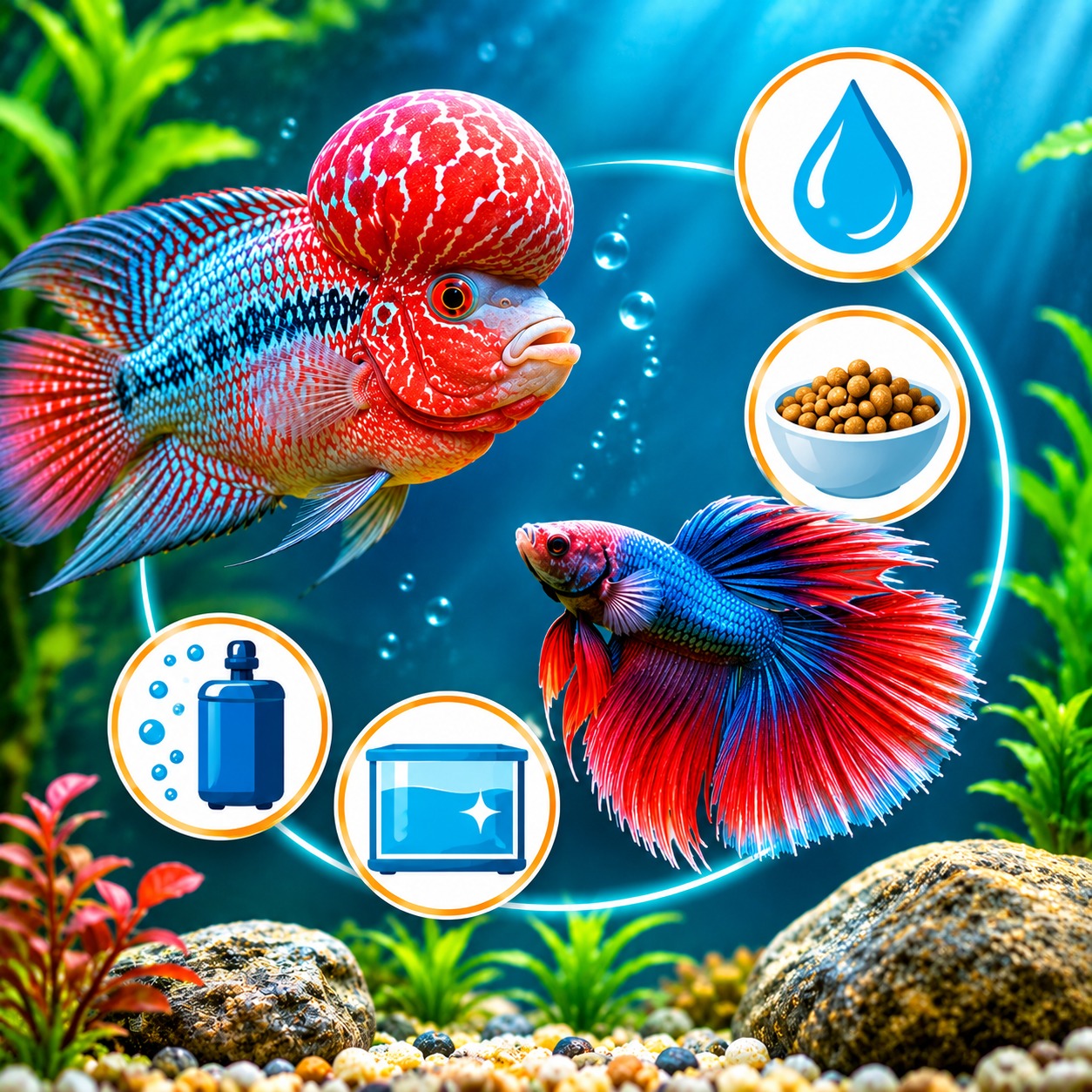
Maintaining good water quality and proper filtration is also important for keeping Flowerhorn fish healthy.
6. The Theory I Find Most Interesting: Two Fish, One Shared Routine
Now we come to the idea I find most interesting.
Imagine that your Flowerhorn and Parrot fish have been living together for a long time.
Every day, they experience many of the same things.
They see the same aquarium surroundings.
They experience the same lighting schedule.
They notice the same feeding routine.
They encounter the same movements outside the glass.
And they share the same water and swimming space.
Over time, both fish may develop habits that fit this shared environment.
The Flowerhorn may learn when food usually appears.
The Parrot fish may learn the same routine.
The Flowerhorn may spend time in a particular area.
The Parrot fish may also visit that area.
One fish moves, and the other notices.
One fish approaches the front glass, and the other may also become active.
After watching this for several days, the fish keeper may begin to notice a repeated pattern.
It can start to look like a connection between the two fish.
Here is the theory I want you to remember:
Perhaps some of the following behaviour is not about one fish choosing another fish. Perhaps it is about two fish learning to respond to the same environment.
This is a possibility, not a proven explanation for every Flowerhorn and Parrot fish pair.
But it gives us a useful way to think about their behaviour.
Instead of asking only, “Why is the Parrot fish following the Flowerhorn?” we can ask a better question.
“What is happening in the aquarium whenever the Parrot fish follows the Flowerhorn?”
Is food about to arrive?
Has the Flowerhorn moved towards a familiar place?
Has something outside the aquarium attracted their attention?
Is the Parrot fish responding to movement?
Or does the same behaviour happen even when nothing obvious is happening?
These are the kinds of questions that turn ordinary fish keeping into an interesting learning experience.
And the best part is that you can investigate them without disturbing your fish.
7. How Can You Test This Theory in Your Own Aquarium?
If you have a Flowerhorn and a Parrot fish living together, you can try a simple observation experiment.
You do not need expensive equipment.
You do not need to change the aquarium.
And you definitely do not need to force the fish to interact.
All you need is patience and a camera.
For the next few days, observe your fish during different parts of their normal routine.
Observation One: Before Feeding
Watch the fish shortly before their usual feeding time.
Does the Flowerhorn become more active?
Does the Parrot fish also become active?
Does the Parrot fish follow the Flowerhorn more often during this period?
Record what you see without tapping on the glass or deliberately provoking either fish.
If the behaviour happens repeatedly before feeding, a learned feeding routine may be one possible explanation.
Observation Two: After Feeding
After feeding, observe them again.
Does the Parrot fish continue following the Flowerhorn?
Do both fish move independently?
Does the behaviour become less frequent?
If the pattern changes after feeding, that may offer another clue about the role of feeding-related activity.
Remember, one observation is not enough to prove a theory.
Look for repeated patterns across several days.
Observation Three: When the Flowerhorn Is Resting
Watch what happens when the Flowerhorn is calm and not actively exploring the tank.
Does the Parrot fish remain nearby?
Does it swim to other areas?
Does it show interest only when the Flowerhorn starts moving again?
This can help you understand whether movement might be influencing the behaviour.
Do not wake, chase, or disturb the Flowerhorn to perform this test.
Simply observe the fish during its normal activity.
Observation Four: Watch Both Fish, Not Just the Follower
This is one of the most important steps.
When we focus only on the Parrot fish, we may miss what the Flowerhorn is doing.
Perhaps the Flowerhorn is swimming towards food.
Perhaps it is exploring a familiar corner.
Perhaps both fish are reacting to something outside the tank.
Try recording both fish in the same frame.
Later, watch the footage and note which fish moves first, whether the other follows, and how often the pattern repeats.
You may discover that the behaviour is less predictable than it first appeared.
Or you may notice a consistent pattern that you had never paid attention to before.
Either result can teach you something.
Observation Five: Watch for Comfort and Stress
While observing the fish, do not focus only on whether they swim together.
Look at their overall condition.
Both fish should have access to food and enough room to swim and move away from each other.
Watch for repeated aggressive chasing, torn fins, injuries, persistent hiding, rapid breathing, or one fish being prevented from eating.
If you notice these problems, do not continue the experiment just to collect footage.
Take steps to protect the fish, including separation if needed.
Their safety is always more important than a video.
8. What If the Parrot Fish Is Following Because of Aggression or Competition?
So far, we have discussed curiosity, learned routines, shared spaces, and familiarity.
But there is another possibility we must not ignore.
Sometimes, a fish may stay close to another fish because of competition, territorial behaviour, or an interaction that is not peaceful.
Following behaviour does not always mean comfort.
For example, one fish may repeatedly approach another, chase it away, or prevent it from reaching certain areas.
In other cases, one fish may follow because both are competing for food or access to a preferred spot.
The context matters.
If the Flowerhorn repeatedly chases the Parrot fish, bites it, or prevents it from eating, this is not something to romanticise as friendship.
Similarly, if the Parrot fish repeatedly pursues the Flowerhorn and the Flowerhorn cannot move away comfortably, that behaviour deserves attention.
Every fish has its own temperament.
Some Flowerhorns may tolerate certain tank mates for long periods, while others may become aggressive. A peaceful pairing today does not guarantee that the same pairing will remain peaceful forever.
Changes in size, maturity, territorial behaviour, and the aquarium environment can affect how fish interact.
This is why anyone keeping these fish together needs a safe backup plan.
A suitable separate aquarium or another safe way to separate them can become important if the relationship changes.
Never assume that two fish are compatible simply because they have shared a tank without obvious problems for a few days.
Observe them regularly and be ready to act if necessary.
9. Why We Sometimes Give Fish Human Emotions
There is another interesting part of this whole discussion, and it has more to do with us than with the fish.
As humans, we naturally search for meaning in behaviour.
When one fish follows another, we may think of friendship.
When a fish approaches the aquarium glass, we may think it is greeting us.
When two fish swim side by side, we may imagine that they enjoy each other’s company.
These interpretations make our experience of fish keeping more personal.
And there is nothing wrong with feeling connected to your fish.
In fact, that connection is one of the reasons many people love keeping aquariums.
But there is a difference between enjoying an interpretation and treating it as a scientific fact.
We cannot know exactly what a particular Parrot fish is thinking simply by watching it follow a Flowerhorn.
We can study its behaviour.
We can observe its routines.
We can compare what happens in different situations.
We can look for signs of stress, comfort, aggression, or curiosity.
But we should be careful about claiming that the fish is in love, jealous, loyal, or deliberately following a friend.
Those are human descriptions, and the behaviour may have a different explanation.
The real story is already interesting without inventing emotions for the fish.
Two different fish sharing an environment can create patterns that are fascinating to watch.
And the more we learn about those patterns, the more thoughtful fish keepers we can become.
10. So, Does My Parrot Fish Follow the Flowerhorn Because It Likes It?
Let us return to our original question.
Why does the Parrot fish always seem to follow the Flowerhorn?
The honest answer is that we cannot know the exact reason from following behaviour alone.
Several explanations are possible.
The Parrot fish may be reacting to the Flowerhorn’s movements.
It may be responding to a learned feeding routine.
Both fish may prefer the same areas of the aquarium.
They may have become familiar with each other’s presence.
Or their behaviour may be influenced by a combination of these factors.
In some situations, following may also be related to competition or aggression, so the full context is important.
If the Parrot fish repeatedly chooses to swim near the Flowerhorn while remaining active, eating normally, and moving freely around the tank, that is useful information.
But it is not enough to prove that the fish has formed a friendship with the Flowerhorn.
The best approach is to observe the behaviour over time and look at the complete picture.
And honestly, this is what makes aquarium keeping so fascinating.
Every day, you may notice something that raises a new question.
A fish changes direction.
Another fish follows.
A familiar routine happens at a slightly different time.
And suddenly, a normal day in your aquarium becomes an opportunity to learn something new.
You do not need to know every answer immediately.
Sometimes, asking the right question is the beginning of understanding your fish better.
11. The Most Important Lesson for Every Fish Keeper
Before we finish, I want you to remember one thing.
Do not judge the relationship between two fish only by how close they swim to each other.
Look at their overall behaviour.
Are both fish eating properly?
Can both swim freely?
Does either fish repeatedly chase or injure the other?
Can each fish move away when it wants to?
Are they maintaining normal activity and body condition?
These observations matter much more than a single moment of swimming together.
If you keep a Flowerhorn and a Parrot fish in the same tank, pay attention to their individual needs as well as their interactions.
Make sure the aquarium has adequate space, reliable filtration, stable water conditions, and appropriate maintenance.
Do not increase stocking or keep an incompatible pair together just because another fish keeper has had success with a similar combination.
Your aquarium is unique, and your fish have their own individual temperaments.
The responsibility is to provide a safe environment for both of them, even when their behaviour is interesting enough to make a great video.
Final Thoughts: Two Fish, One Aquarium, Many Questions
So, the next time you see your Parrot fish following your Flowerhorn, take a moment before deciding what it means.
Watch carefully.
Does the behaviour happen before feeding?
Does it happen when the Flowerhorn moves?
Does the Parrot fish follow into every area, or do both fish simply prefer the same places?
And most importantly, do both fish appear healthy and have the freedom to move away from each other?
Perhaps you will discover that the Parrot fish is responding to a familiar routine.
Perhaps movement is attracting its attention.
Or perhaps several factors are influencing the behaviour at the same time.
We may not be able to read the minds of our fish, but we can learn a lot by observing them patiently.
And that is the idea behind Blue Aquatics.
We do not just look at fish because they are colourful or beautiful. We try to understand the little things they do every day.
Because sometimes, the most interesting aquarium stories begin with the simplest question.
Why is one fish following the other?
Now I want to hear from you.
Have you ever kept a Flowerhorn and a Parrot fish together? Does your Parrot fish also follow the Flowerhorn, or do your fish behave differently?
Share your experience in the comments. Your observation might help another fish keeper understand their own aquarium better.
If you enjoyed this video, like it, subscribe to Blue Aquatics, and join us for more real-life fish behaviour, aquarium tips, and interesting stories from the underwater world.
Until next time, keep observing your fish, keep learning, and keep your aquarium healthy.
Frequently Asked Questions
Why does my Parrot fish follow my Flowerhorn?
It may be responding to the Flowerhorn’s movements, following a feeding routine, or visiting the same areas of the aquarium.
Does a Parrot fish follow a Flowerhorn because it likes it?
Not necessarily. Following behaviour alone cannot prove friendship or affection.
Can a Flowerhorn and a Parrot fish live together peacefully?
Sometimes, but compatibility depends on their individual temperament, tank conditions, and behaviour over time.
Is it normal for a Parrot fish to follow another fish?
It can be normal, but watch for aggression, repeated chasing, injuries, or signs of stress.
Disclaimer
Disclaimer: This content is intended for general aquarium care and educational purposes. The reasons behind a Parrot fish following a Flowerhorn may vary depending on individual behaviour, feeding routines, environmental conditions, and interactions. Following behaviour alone does not prove friendship, affection, or compatibility. Monitor both fish for signs of stress, aggression, or injury, maintain suitable water quality, and separate them if their safety is at risk. Consult an experienced aquarist or aquatic veterinarian if either fish shows persistent signs of illness or distress.
Search Articles
Categories




Join the Blue Aquatics Community
Stay updated with the newest tips, guides, and aquarium knowledge.